ClawRouter: The Only LLM Router Built for Autonomous Agents (Open Source, USDC on Base)
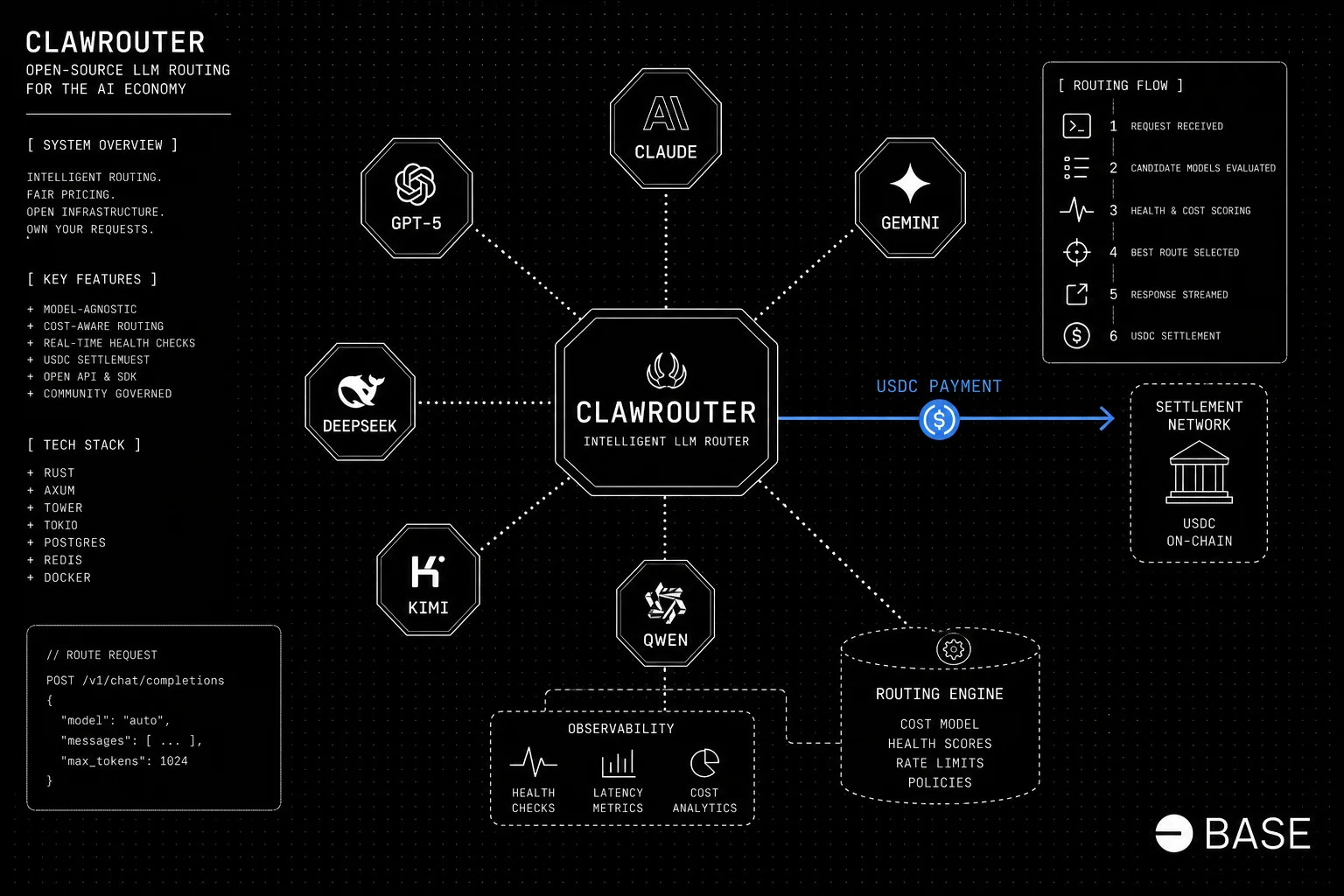

TL;DR — Every other LLM router was built for human developers: create an account, get an API key, pick a model from a dashboard, pay with a credit card. Agents can't do any of that. ClawRouter is the only open-source LLM router built for the agent-first world — wallet signature is authentication, USDC per-request via x402 is the payment, 15-dimension scoring picks the model in under 1 ms locally, 9 NVIDIA models are free forever (including DeepSeek V4 Pro/Flash at 1M context and Nemotron Nano Omni with vision). MIT licensed. 2025 USDC Hackathon — Agentic Commerce winner.
The premise nobody else takes seriously
We tried to build agent infrastructure on top of OpenRouter, LiteLLM, Martian, Portkey. Each one has the same fatal flaw, and we kept hitting it the same way:
An autonomous agent cannot create a developer account. It cannot answer a phone-verification SMS, cannot click a "verify your email" link, cannot type a credit-card number, cannot agree to a Terms of Service. An agent has exactly one capability the human web doesn't yet recognize: it can sign a transaction.
If your router needs an API key to authenticate, your agent can't get one without a human. If your router needs a credit card to pay, your agent can't open one without a human. The moment you put a human in the loop "just for setup," you have made every claim about autonomy a marketing line.
ClawRouter is what falls out of taking that constraint as a hard requirement, not a wish.
The 5-box test
| OpenRouter | LiteLLM | Martian | Portkey | ClawRouter | |
|---|---|---|---|---|---|
| Open source | ❌ | ✅ | ❌ | Partial | ✅ |
| Smart routing | ❌ manual select | ❌ manual select | ✅ closed | ❌ observability | ✅ open source |
| Runs locally | ❌ | ✅ | ❌ | ❌ | ✅ |
| Crypto-native auth | ❌ account + key | ❌ BYO keys | ❌ account + key | ❌ account + key | ✅ wallet signature |
| Agent-ready | ❌ | ❌ | ❌ | ❌ | ✅ |
Five boxes. Every other router checks one or two. ClawRouter is the only stack that checks all five — and the reason none of the others do is they were each designed before "an agent is the user" was a business reality.
What "agent-native" actually means
It's three architectural decisions that are downstream of the autonomy constraint:
1. Wallet signature is authentication
Your wallet is your identity. There's no API key, no email, no account. ClawRouter generates a wallet locally on first run; the private key never leaves your machine. Every request is signed by that wallet, and the signature is the auth. Lose the wallet, lose access — same security model the rest of crypto already accepts.
This means an agent can install ClawRouter, generate its own wallet, and start using free models without a human ever entering setup data. That has not been possible anywhere else in LLM infrastructure.
2. USDC per-request via x402
ClawRouter doesn't bill you. Every request returns an HTTP 402 Payment Required with the price in the header. The wallet signs a USDC payment payload, retries the request, and the gateway settles it on Base or Solana in seconds. No subscription, no monthly invoice, no 30-day net.
Concretely: when your agent fires off a claude-sonnet-4.6 call that costs $0.0090, the wallet signs that exact amount via x402, USDC settles on Base in ~1.8 seconds, and the response comes back in the same HTTP round-trip. The agent never holds funds it isn't actively spending.
3. 15-dimension routing — fully local, sub-1 ms
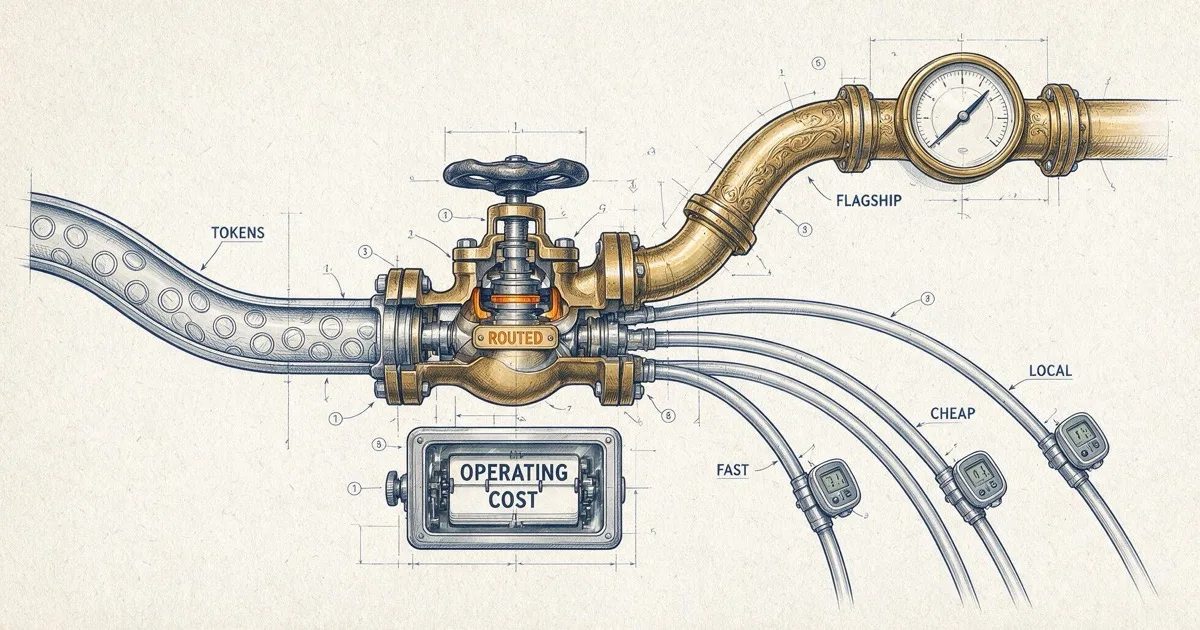
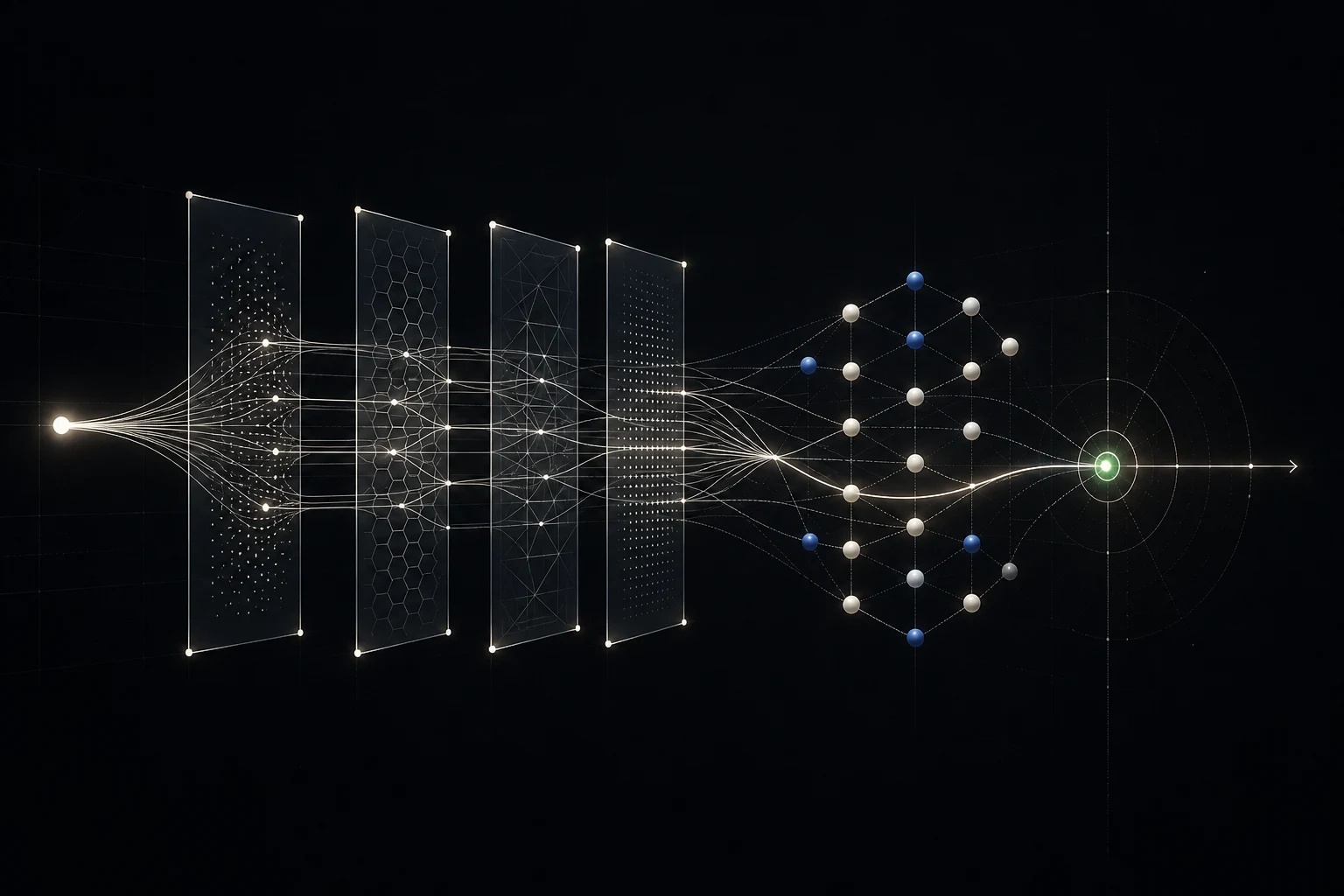
Most "smart routers" are closed-source services that add a network hop. ClawRouter analyzes each request across 15 dimensions — task type (code, reasoning, chat, summarize, vision), token count, complexity, context window, latency budget, and 10 others — entirely on your local machine. The decision takes under 1 millisecond and never makes an external API call.
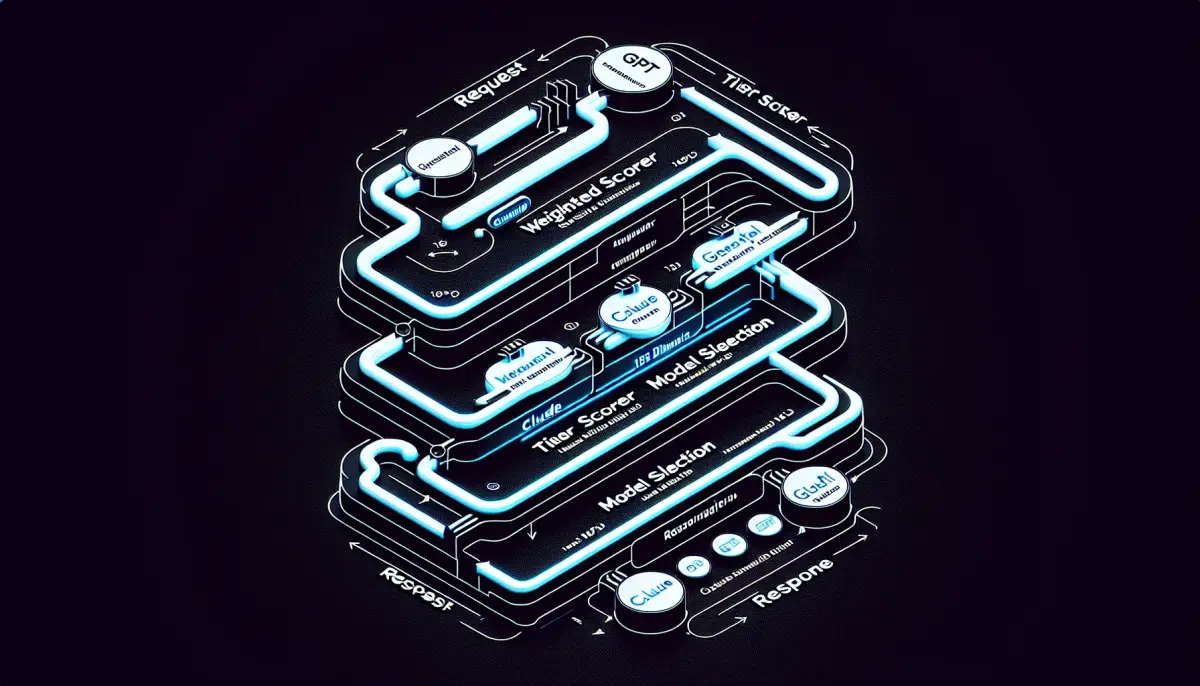
Request → Weighted Scorer (15 dims) → Tier (SIMPLE/MEDIUM/COMPLEX/REASONING) → Best Model → Response
The tier × profile matrix:
| Tier | ECO model | AUTO model | PREMIUM model |
|---|---|---|---|
| SIMPLE | nvidia/deepseek-v4-flash (FREE) | gemini-2.5-flash ($0.30/$2.50) | kimi-k2.5 |
| MEDIUM | gemini-3.1-flash-lite ($0.25/$1.50) | kimi-k2.5 ($0.60/$3.00) | gpt-5.3-codex ($1.75/$14.00) |
| COMPLEX | gemini-3.1-flash-lite ($0.25/$1.50) | gemini-3.1-pro ($2/$12) | claude-opus-4.6 ($5/$25) |
| REASONING | grok-4-1-fast ($0.20/$0.50) | grok-4-1-fast-reasoning ($0.20/$0.50) | claude-sonnet-4.6 ($3/$15) |
Blended average: $2.05/M tokens vs $25/M for Claude Opus = 92% savings for users who never picked a model and never even noticed the routing happened.
Routing profiles you can actually type
Inside an agent (e.g. OpenClaw), users switch profiles with a slash command:
| Command | Strategy | Savings | When |
|---|---|---|---|
/model free | Free NVIDIA models only | 100% | $0 wallet, learning, eval |
/model auto | Balanced quality-to-cost (default) | 74–100% | General use |
/model eco | Cheapest possible | 95–100% | Maximum savings |
/model premium | Best quality regardless of cost | 0% | Mission-critical |
Plus targeted shortcuts: /model grok, /model br-sonnet, /model gpt5, /model o3 — pin to a specific model when you need it.
The "free tier without crypto" path
This is the part most agent infrastructure gets wrong. If onboarding requires a wallet, a fund-it step, and a successful first transaction — most users bail before they see the product work. ClawRouter cuts through:
9 NVIDIA models work for free, no wallet balance required. Install, run, pin
nvidia/deepseek-v4-pro. No crypto, no signup, no balance. Add USDC later when you want paid models.
The 9 free models cover the cost-curve where a free tier is meaningful: deepseek-v4-pro (1M context, flagship reasoning), deepseek-v4-flash (1M context, fast chat), nemotron-3-nano-omni-30b-a3b-reasoning (256K context, vision — text + images + video + audio), qwen3-next-80b-a3b-thinking, qwen3-coder-480b, glm-4.7, llama-4-maverick, mistral-small-4-119b, and deepseek-v3.2 (legacy, auto-upgrades to V4 Pro). All NVIDIA-hosted, several with reasoning + coding specializations. Last refreshed 2026-04-28; the older gpt-oss-120b/20b were retired the same day on data-privacy grounds (NVIDIA's free tier reserves the right to train on prompts).
That makes ClawRouter the rare router where the first message costs nothing, even before the user hears the word "wallet."
More than chat: image, video, image-edit
A modern agent needs image and video too. ClawRouter ships them in the same proxy:
/imagegen a dog dancing on the beach
/imagegen --model dall-e-3 a futuristic city at sunset
/videogen a red apple slowly spinning
/videogen --model seedance-2-fast --duration=5 a cat waving
/img2img --image ~/photo.png change the background to a starry sky
Same wallet, same x402 flow. Every image / video / edit is a signed USDC payment for the exact upstream price plus 5% margin. DALL-E 3, GPT Image, Google Nano Banana, xAI Grok Imagine, Zhipu CogView-4, Black Forest Flux — all reachable from one CLI without an API key from any of them.
This is the part that turns ClawRouter from "LLM router" into "agent-economy front door": one wallet, every modality, no per-vendor account-creation friction.
Why Base specifically
Per-request USDC settlement only works if every layer cooperates. We tried each option, and Base was the one where the math holds:
- Sub-2-second finality — the agent can pipeline the next call immediately after settlement.
- Sub-cent gas — a $0.001 LLM call doesn't get eaten alive by network fees the way it would on Ethereum L1.
- USDC native — no FX risk, no bridging, no "wait for bridge confirmations".
- x402 protocol — Coinbase co-created x402, so HTTP itself becomes the payment rail; agents don't need to learn smart-contract calls.
- Solana parallel — for users who prefer Solana, ClawRouter pays USDC there too. Both wallets are derived from a single BIP-39 mnemonic on first run.
Every other settlement layer makes the unit economics impossible. Stripe minimum charges + 2.9% fees torpedo a $0.0008 micropayment. Ethereum L1 gas alone exceeds the call cost. Solana works on its own (and we ship there too) but Base is where most of the agent ecosystem and Coinbase's developer surface area live in 2026.
Try it
OpenClaw users — ClawRouter installs as a plugin:
curl -fsSL https://blockrun.ai/ClawRouter-update | bash
openclaw gateway restart
Smart routing (blockrun/auto) is now the default model.
Standalone (continue.dev, Cursor, VS Code, any OpenAI-compatible client) — runs as a local proxy on port 8402:
npx @blockrun/clawrouter
Point your client at http://localhost:8402/v1/ with API key x402. Pin blockrun/auto for smart routing, or pick a specific model from blockrun.ai/models.
For Claude Code — see BRCC, the same idea purpose-built for the Anthropic CLI.
The wallet generates locally on first run; 9 NVIDIA models work free with no funding. Send a few USDC on Base or Solana to unlock paid models — $5 covers thousands of requests.
What ClawRouter is not
For honesty's sake — there are things ClawRouter does not try to do, and some of the things people expect from a "router":
- It's not a SaaS gateway. It runs on your machine. If you want a hosted gateway with the same routing logic, that's BlockRun — same team, hosted product. ClawRouter is the open client.
- It doesn't do RAG. No vector store, no document indexing. It's a router, not an assistant framework.
- It doesn't do agent orchestration. It serves one HTTP request, picks the best model, returns the answer. Multi-step planning is your agent's job (or Franklin's).
- It's not a model. It's a model picker. The capability still lives upstream.
That deliberate scope is what lets it be 1ms and 800 lines of routable code instead of a multi-megabyte framework.
Where we're going next
- Provisioned cross-region routing — load-balance across us-east, us-west, eu-central inference profiles automatically.
- Streaming compression — apply token compression mid-stream for very long agent loops.
- Webhook-based budget alerts — push "you're at 80%" the moment it happens, not in a polling loop.
- More agent integrations — currently OpenClaw plugin + standalone proxy. Next: deeper hooks into Cursor, Continue, Cline, Aider, and any OpenAI-compatible client where the routing decision is currently a human's manual choice.
- Solana parity — both chains work today; Solana-side improvements coming alongside the Base ones.
Links
- GitHub: github.com/BlockRunAI/ClawRouter (MIT license)
- npm: @blockrun/clawrouter
- Hosted gateway: blockrun.ai — same routing logic + 55+ models you can call directly
- x402 protocol: x402.org
- Base: base.org
- Telegram community: t.me/blockrunAI
- Founder: @bc1max on Telegram
If you're building an AI agent on Base and your bill of materials includes "manual API-key management" or "user creates account before first call," ClawRouter removes both line items. PRs, issues, and partnership pitches all welcome.
— The BlockRun team