OpenClaw Is Burning Your Budget and Stalling Your Agents — 4 Fixes From the Issue Tracker
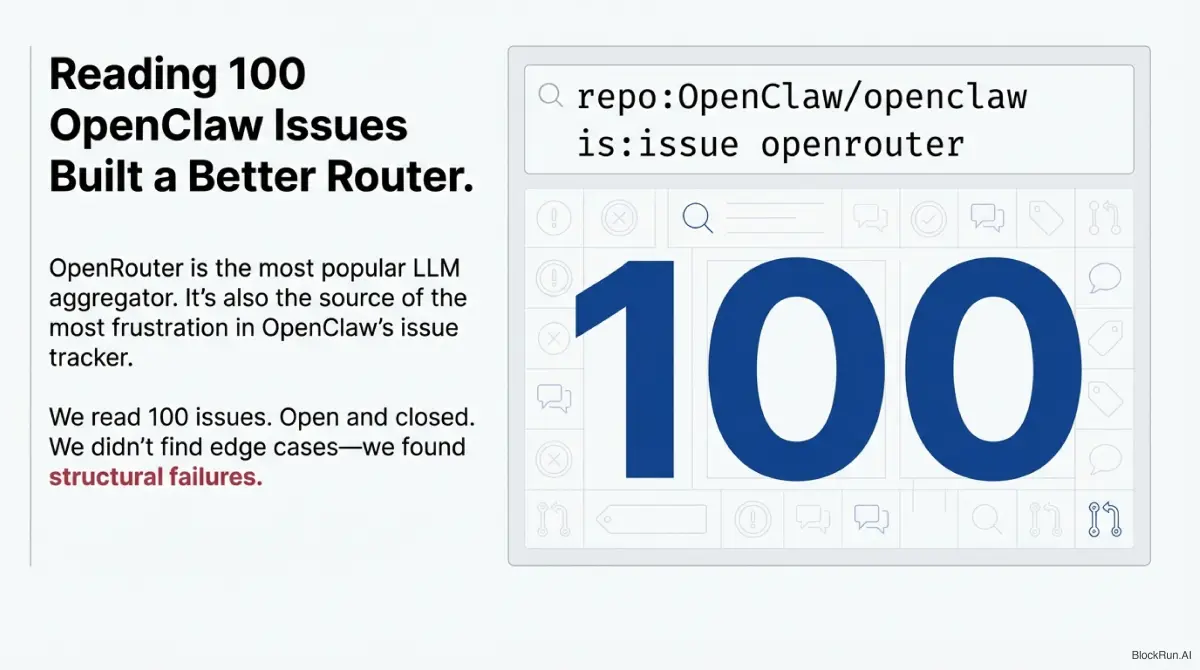
We searched OpenClaw's issue tracker for the problems users actually hit in production — cost, outages, runaway agents, model selection. Four structural problems show up again and again. ClawRouter fixes all four.
The data
OpenClaw is a superb agent harness. But running it in production surfaces the same handful of structural problems — and they're not edge cases, they're consequences of how a single-model, single-provider setup behaves under real load. We read the open issues and grouped them:
| Problem | Representative issues |
|---|---|
| Cost spikes from background work | #90170, #81856, #72964, #48579, #84218, #65161 |
| Provider outages stall the session | #84865, #47910, #79611, #62615 |
| No spend ceiling for autonomous agents | #42475, #17683, #64463, #13219 |
| One model for every task | #43260, #80521, #65557, #88371 |
ClawRouter is a local router that sits between OpenClaw and the model providers. Every request — including the internal ones — goes through blockrun/auto, which classifies the call across 15 dimensions in under a millisecond and routes it to the cheapest model that can actually handle it. That single architectural move addresses all four problems below.
1. Your bill spiked 10x and you didn't change a thing
You didn't add agents. You didn't change models. But your token usage tripled. The cost isn't in the prompts you wrote — it's in the work the agent does between them: context compaction, heartbeat replays, and memory lookups that run on every turn and quietly burn tokens on whatever model is configured.
From #90170: "Possible token/cost regression after OpenClaw v2026.5.28." A version bump, not a usage change, moved the needle.
The culprits are internal:
- Compaction firing too often, on the wrong model. #72964 and #48579 document premature compactions; #81856 asks for an absolute-token trigger because on a 1M-context model, summarizing hundreds of thousands of tokens at flagship rates — repeatedly — is ruinous.
- Heartbeats replaying context. #84218 and #65161 (14 comments) show idle beats that stay heavy, so every beat costs like an active one.
How ClawRouter fixes it
Route the expensive internal lanes to cheap or free models. Point compaction and memory at a cost profile instead of your premium default:
{
  "agents": {
    "main": {
      "model": "blockrun/auto",
      "compaction": { "model": "blockrun/eco" }, // summaries don't need a flagship
      "memory": { "model": "blockrun/free" } // lookups can be free
    }
  }
}
The free tier alone covers most internal work — NVIDIA-hosted models with up to 1M context and a vision-capable Nemotron Omni, at zero cost. A compaction call billed at flagship rates becomes free, hundreds of times a day. On top of that, ClawRouter compresses verbose tool outputs and serves repeated responses from a short-TTL cache before any paid call goes out (the full teardown is in How ClawRouter Cuts LLM API Costs 500×).
2. A provider goes down and your agent stalls for 14 minutes
The moment you pin OpenClaw to one model, you've built a single point of failure. When that provider has a bad minute — a 503, a rate-limit burst, an auth token that won't refresh — there's nothing behind it.
From #84865: "user-switched model has no fallback chain, causing session deadlock on provider outage." The act of choosing a model — what a careful user does — strips the safety net.
And naive failover isn't enough: #47910 asks for fallback by failure class, because a 429 is transient (retry) while a 401 is not (skip immediately). #62615 asks for a circuit breaker so a degraded provider can't drag the whole session down.
How ClawRouter fixes it
When OpenClaw points at blockrun/auto, you're pointed at a router with a fallback chain behind every tier — primary plus an ordered list of fallbacks spanning different providers, so one outage doesn't poison the others.
[ClawRouter] tier=MEDIUM
[ClawRouter] primary moonshot/kimi-k2.6 → 503, falling through chain
[ClawRouter] trying next: google/gemini-3-flash-preview → ok
ClawRouter also classifies failures before reacting — auth errors (401/403) skip straight to the next model instead of burning ~10s per retry; transient errors cascade; payment-simulation hiccups retry with a different model. The agent never sees a bare 503. And the bottom of every chain is the free tier, which isn't tied to any paid provider's uptime — so the worst case is "this turn ran on a free model for a minute," not "the gateway hung until I restarted it."
| Failure mode | Pinned single model | ClawRouter (blockrun/auto) |
|---|---|---|
| Provider returns 503 | Session stalls / deadlocks | Falls to next model in chain |
| 401 / auth won't refresh | ~10s wasted, then error | Classified, skips straight to next model |
| Every paid provider unavailable | Hard failure | Completes on a free model |
3. There's no spend ceiling on an autonomous agent
A human agent stops spending when they go to sleep. An autonomous one doesn't — the whole point is that it runs without you, which means a runaway loop spends without you too.
OpenClaw users have asked for an enforced ceiling for a long time. #42475 (11 comments): "Per-agent cost budget enforcement at the gateway level." #17683: "Scoped / Script-Limited Agent Mode." #64463: "session.maxTokensPerSession." The common thread: a limit the agent cannot exceed, enforced by infrastructure rather than the agent's own good behavior.
How ClawRouter fixes it
ClawRouter enforces a per-run (per-session) dollar ceiling via maxCostPerRunUsd, with two modes:
{
  "maxCostPerRunUsd": 0.5,
  "maxCostPerRunMode": "graceful"
}
graceful(default) — as the session nears its budget, ClawRouter downgrades to cheaper models and falls back to a free model as a last resort. Work continues, cheaper.strict— the moment session spend reaches the cap, it returns a429and stops. A run that physically cannot exceed its number — exactly the predictable behavior #17683 describes.
Two more guardrails: /exclude removes your most expensive models from routing entirely (including every fallback chain), so a loop can't escalate into them — and the wallet balance itself is a hard ceiling: fund it with only what you're willing to spend, and the agent literally cannot exceed it. /stats shows what was spent and which models served the requests — the per-model visibility #13219 is asking for.
4. One model handles your hardest task and your most trivial one — at the same price
OpenClaw lets you pick a model. Singular. It then handles your hardest reasoning task and a one-line reformat at the same per-token price. Users keep asking for finer control: per-skill model routing (#43260, 8 comments), a model picker (#80521), per-account allowlists (#65557). And the default pick can quietly be an expensive one — #88371: a brand-new user's first message bills against a premium API with no warning.
How ClawRouter fixes it
Automatic per-task routing. blockrun/auto classifies every individual request and routes it to the cheapest capable model — no per-task config:
"reformat this JSON"        → simple tier  → fast, cheap model
"refactor this module"      → complex tier → flagship-quality model
"prove this invariant"      → reasoning    → reasoning model
Explicit per-agent control when you want it. Assign a profile per lane in openclaw.json — blockrun/premium for coding, blockrun/free for formatting — each with its own fallback chain. And clean aliases (sonnet, opus, flash, grok, gpt5) mean switching is one word (/model grok), with none of the provider/provider/model mangling that fills the tracker. The default itself is cost-safe: a fresh install routes to blockrun/auto and the free tier works with no balance, so nobody's first message silently hits a premium API.
The fix is one decision
All four problems share a root cause — a single model, chosen once, doing everything, with nothing behind it — and a single fix: route through blockrun/auto and let a local router classify, price, and fail over each request on its own merits.
- Set your primary to
blockrun/auto. - Point compaction and memory at
blockrun/eco/blockrun/free. - Set
maxCostPerRunUsdon anything autonomous;/excludethe models you never want reached. - Run
/statsafter a day and tune.
An autonomous agent is only as good as its worst provider-minute and its largest unmonitored bill. Fix both at the router, once.
curl -fsSL https://blockrun.ai/ClawRouter-update | bash
openclaw gateway restart
ClawRouter is open source (MIT) on GitHub: BlockRunAI/ClawRouter — 55+ models, free to start, USDC via x402 on Base & Solana.