Claude Opus 5.5, Sonnet 5.5 and Grok 4.7 Are Live
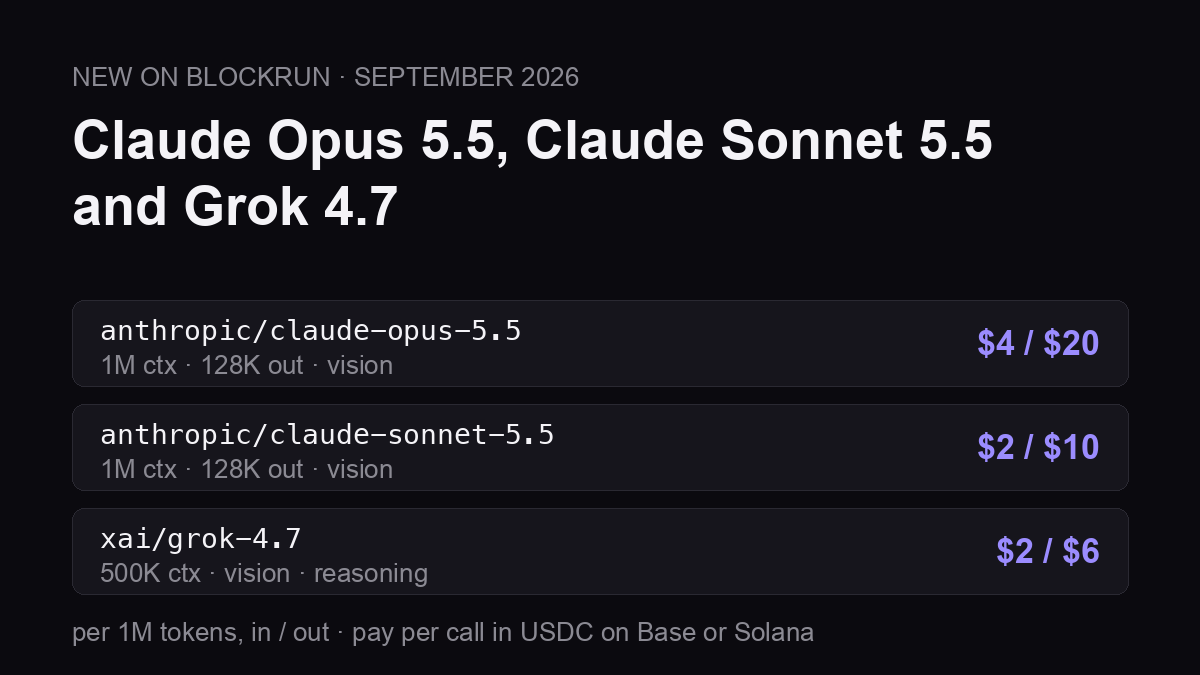
Three new frontier models are live on BlockRun today, on Base and on Solana:
| Model | Input / 1M | Output / 1M | Context | Max output |
|---|---|---|---|---|
anthropic/claude-opus-5.5 | $4.00 | $20.00 | 1M | 128K |
anthropic/claude-sonnet-5.5 | $2.00 | $10.00 | 1M | 128K |
xai/grok-4.7 | $2.00 | $6.00 | 500K | — |
All three take images. There is no API key and no subscription: every call is quoted in dollars before it runs and paid per call in USDC.
Claude Opus 5.5 — the new Opus costs less than the old one
Opus 5.5 is Anthropic's newest Opus, for the work where the answer has to be right: long agentic coding runs, deep multi-step reasoning, careful writing over a large context.
The unusual part is the price. At $4 in / $20 out it is cheaper than the Opus 5 it succeeds ($5 / $25). Prompt-cache reads are cheaper still: $0.20 per 1M, which is 0.05x the input price where other Claude models read at 0.1x. If you run an agent that resends a long system prompt or a large codebase on every turn, that cache rate is most of your bill — and it is $0.20 here against $0.50 on Opus 5.
Thinking is always on. Keep answers short and cheap with a low effort rather than trying to switch it off — more on that below.
Claude Sonnet 5.5 — the everyday workhorse
Sonnet 5.5 is the model to reach for by default: fast, capable coding and agent work at $2 / $10, the same price as Sonnet 5, with the same 1M context and 128K output.
If Sonnet 5.5's upstream is ever unavailable, the gateway falls back to Sonnet 5 at the same rate. A rescue never costs you more than the request you sent.
Grok 4.7 — xAI's new flagship
Grok 4.7 brings a 500K context, image input and always-on reasoning with a
selectable effort from low to xhigh, at $2 / $6. It also answers with
Live Search — web, news and X results pulled in at request time, at $0.025 per
source used. Like the rest of the
Grok family it bills at double those rates once a prompt reaches 200K tokens,
which is exactly how xAI bills it — BlockRun passes model prices through with no
markup. It falls back to Grok 4.6 at the same price.
Calling them
The chat endpoint is OpenAI-compatible, and the SDK handles the payment. On Base:
from blockrun_llm import LLMClient

client = LLMClient()  # wallet from BLOCKRUN_WALLET_KEY or ~/.blockrun/.session
print(client.chat("anthropic/claude-opus-5.5", "Review this migration plan for risks."))
On Solana, the same call with the Solana client:
from blockrun_llm import SolanaLLMClient

client = SolanaLLMClient()  # wallet from SOLANA_WALLET_KEY; pays USDC on Solana
print(client.chat("xai/grok-4.7", "Summarise this contract in five bullets."))
And if you already use Anthropic's Messages API, point it at BlockRun and keep
your code: POST /v1/messages accepts both our ids and Anthropic's own
(claude-opus-5-5, claude-sonnet-5-5).
What changed in the request format — and why you don't have to care
The two new Claude models are stricter than Opus 5 and Sonnet 5 about three request fields. Sent as-is, each would be rejected. The gateway translates them for you, so a request that works on Opus 5 works on Opus 5.5 unchanged:
- Forced tool choice. Both models reject
tool_choice: "required"or a named tool. The gateway sendsautoinstead. The model still calls the tool in the overwhelming majority of cases; if a call must happen, name the tool in your prompt. - Turning thinking off. Opus 5.5 has no off switch, so a request that asks for
thinking to be disabled is served with adaptive thinking — use a low
output_config.effortto keep it brief. Sonnet 5.5 does have one, but renamed itbetween_tools; the gateway translates the olddisabledfor you and caps effort athigh, the most that mode allows. - Sampling parameters.
temperature,top_pandtop_kare not accepted by either model. The gateway drops them rather than failing the call; steer with the prompt instead.
We checked every one of these against the live models before listing — and checked the older models alongside, so that a rule meant for Opus 5.5 does not quietly change how Opus 5 behaves.
Try them
The full catalog, with live prices, is at blockrun.ai/models, and the docs cover each model's request rules. Pick one, send a request, and the price comes back before the work does.